Best Cafetières UK 2026: Top French Presses Compared
Last updated: 2026-07 · Rankings built from real owner discussions — every source linked below.
A cafetière is still the cheapest route to properly good coffee at home: no pods, no paper filters, no machine on the worktop — just coarse-ground coffee, hot water and four minutes of patience. But with everything from £12 supermarket presses to £70 stoneware on the shelves, it's hard to know where the money actually goes.
To cut through it, we combined current Amazon UK listings with what real owners say on UK communities such as Mumsnet and Coffee Forums UK. The recurring theme from experienced users is refreshingly honest: a cafetière is a simple device, so build quality, ease of cleaning and heat retention are what separate the good from the annoying — and your grind, ratio and steep time matter more than the badge on the pot.
Below are five presses that keep coming up in owner discussions and hold their own on Amazon UK: the classic Bodum Chambord, its cheaper Caffettiera sibling, the sediment-taming Espro P3, a double-walled stainless VonShef for the clumsy and the caravan crowd, and Le Creuset's stoneware press for those who want a cafetière that doubles as kitchen furniture.
Bodum Chambord French Press Coffee Maker, 1L / 8 Cup
£25–£35
The Chambord is the archetypal cafetière — a borosilicate glass beaker in a polished stainless frame, made in Portugal to a design that's barely changed since the 1950s. It pours cleanly, comes apart completely for washing, and replacement beakers and filters are cheap and easy to find, which is why so many owners keep one for a decade or more. If you only ever buy one cafetière, this is the default answer.
Pros
✓Timeless design with fully replaceable glass beaker and filter parts
✓Stainless mesh and frame strip down completely for cleaning
✓Dishwasher-safe and BPA-free; multiple sizes and finishes available
Cons
✗Single-wall glass loses heat quickly, so coffee cools fast
✗Glass will break if knocked — clumsy households should go stainless
✗Some sediment in the cup, as with any metal-mesh press
What owners say
Mumsnet posters describe Bodum as the market leader for cafetières and rate presses like this that can be taken apart fully for cleaning.
Bodum Caffettiera French Press Coffee Maker, 1L / 8 Cup, Black
£15–£25
The Caffettiera is the same Portuguese-made borosilicate beaker and stainless filter as the Chambord, wrapped in a cheaper polypropylene frame and lid. It brews an identical cup for noticeably less money, and the plastic collar actually protects the glass better in a busy kitchen. It just doesn't look as smart on the table — which is the only real reason to pay more.
Pros
✓Same glass beaker and stainless mesh filter as the pricier Chambord
✓Plastic frame shrugs off knocks and stays cooler to handle
✓Spare beakers and filters are interchangeable with other Bodum presses
Cons
✗Plastic lid and frame look and feel cheaper than the Chambord
✗Single-wall glass still loses heat quickly
✗Black plastic can dull with repeated dishwasher cycles
What owners say
Coffee Forums UK users make the value case for presses like this: the device is so simple that ratio, grind, steep time and decanting matter far more than what you spend on the pot.
Espro P3 Cafetière French Press with Double Micro-Filter, 950ml
£35–£50
Espro's P3 answers the classic cafetière complaint — sludge at the bottom of the cup. Its patented double micro-filter basket traps grounds twice over and its silicone seals stop extraction once you plunge, so the last pour tastes like the first. The glass is thicker than a standard press too. It costs more than a Bodum and the filter basket takes longer to wash, but for a genuinely grit-free press-pot cup it's the one to buy.
Pros
✓Double micro-mesh filter delivers a dramatically cleaner, near grit-free cup
✓Sealed basket halts extraction after plunging, so coffee doesn't turn bitter in the pot
✓Thicker borosilicate glass than a standard press, with a safety-lock frame
Cons
✗Roughly twice the price of a basic glass cafetière
✗Two-stage filter basket is fiddlier to clean than a simple mesh
✗Slightly less body in the cup — some press fans miss the heavier texture
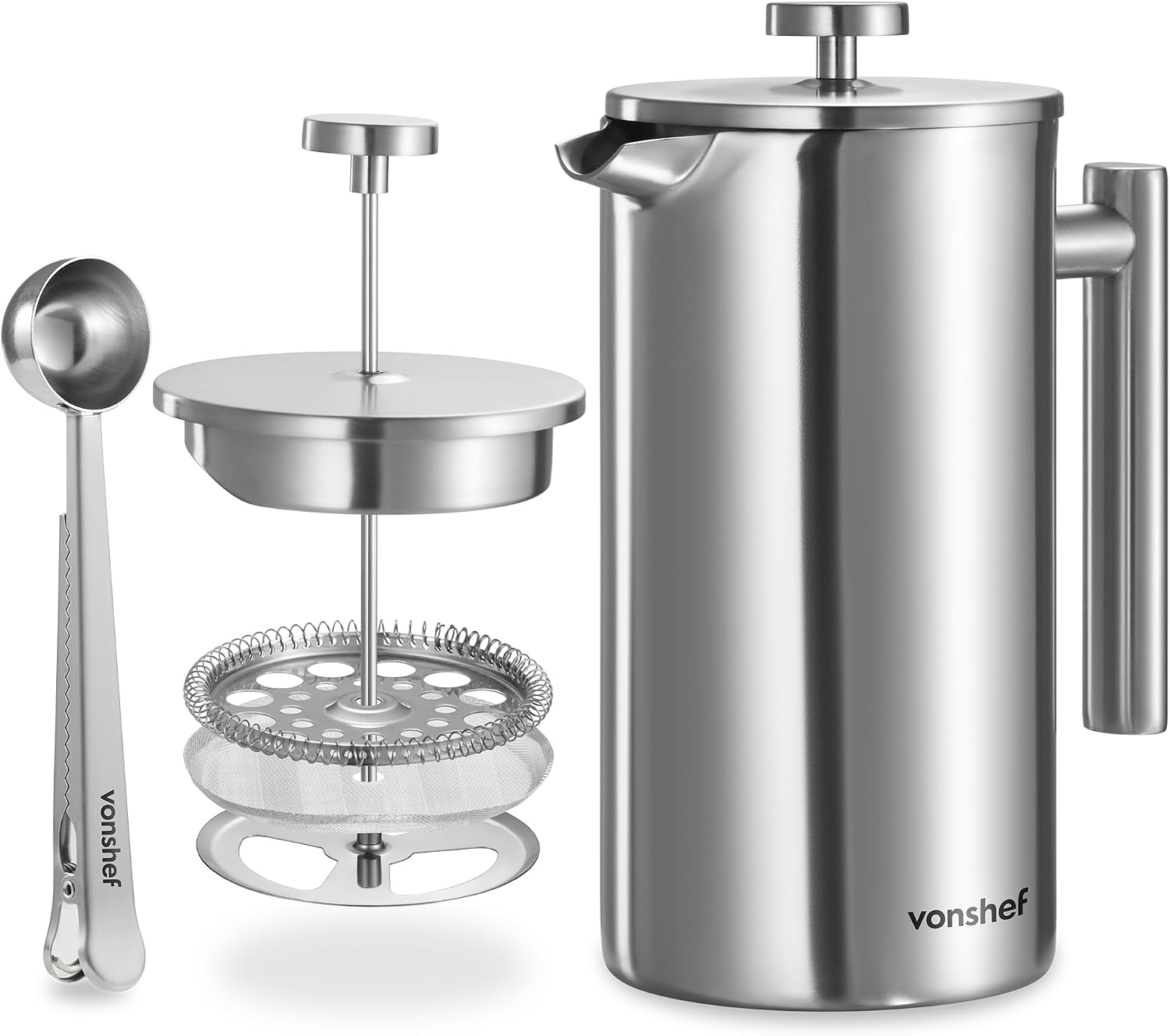
VonShef 12 Cup Cafetière, 1.5L Double-Walled Stainless Steel French Press
£20–£30
If you've broken a glass beaker or two, VonShef's brushed stainless press is the pragmatic fix: a double-walled 1.5L flask that's effectively unbreakable and keeps coffee hot far longer than single-wall glass. It comes with a measuring spoon and bag clip, and the big capacity suits households that brew for several people at once. It's not a looker next to a Chambord, but it will still be working long after a glass press has met the kitchen floor.
Pros
✓Double-walled stainless body keeps coffee hot much longer than glass
✓Effectively unbreakable — good for busy kitchens, offices and camping
✓Generous 1.5L capacity with measuring spoon included
Cons
✗You can't see the brew, so timing and ratio need more care
✗Utilitarian looks compared with glass-and-chrome presses
✗Large size is overkill for one or two cups
What owners say
UK forum users who switch to double-walled stainless presses tend not to go back — one Mumsnet poster gave away their glass cafetières because the steel one proved virtually indestructible, while Coffee Forums UK members note glass beakers 'just keep breaking'.
Le Creuset Stoneware Cafetière with Stainless Steel Plunger, 1L, Volcanic
£50–£70
Le Creuset's cafetière swaps glass for thick enamelled stoneware in the brand's signature colours, backed by a 10-year guarantee. The stoneware holds heat well once warmed, the enamel resists staining, and the metal plunger dismantles for cleaning — it's dishwasher safe too. You're paying a premium for the badge and the looks, but as a cafetière that matches the rest of a Le Creuset kitchen and survives daily use for years, it delivers.
Pros
✓Thick stoneware retains heat well once pre-warmed
We read through public discussions on Reddit and UK forums so you don't have to. Every quote links to its
original thread — click through and read the full conversation.
Across UK communities — Mumsnet's cafetière threads and Coffee Forums UK — the consensus is consistent: Bodum is the default brand ('the market leader'), and because a cafetière is such a simple device, technique (coarse grind, sensible ratio, 4-minute steep, decant promptly) matters more than which press you buy. The practical debates are about materials rather than brands: glass looks best but breaks and loses heat, so repeat buyers often end up with double-walled stainless; Le Creuset owners swear by pre-warming the stoneware; and everyone agrees a press you can fully dismantle for cleaning beats one you can't. Note: Reddit's r/Coffee could not be accessed for this update, so the consensus above is drawn from the UK forums we could verify directly.
“The market leader is Bodum and they do excellent cafetières — or if you want a single-cup device, look at the AeroPress.”
“Unless it's a specific style you're after, a cafetière is a cafetière — ideally you want something that can be taken apart to be cleaned, like the Bodum ones.”
“I loved my steel double-walled cafetière so much I gave away my glass ones — they're virtually indestructible, apart from the plastic button on the plunger.”
Borosilicate glass (Bodum Chambord, Caffettiera, Espro P3) is the classic choice: you can watch the brew and beakers are cheap to replace — but single-wall glass loses heat fast and breaks when dropped. Double-walled stainless steel (VonShef and similar) is effectively unbreakable and keeps coffee hot two to three times longer, at the cost of not being able to see inside. Stoneware (Le Creuset) sits between the two: excellent heat retention once pre-warmed and very durable in normal use, but heavy and opaque. Experienced UK forum users who brew daily often migrate to stainless after their second broken beaker.
Filters and sediment: how clean do you want your cup?
Every cafetière uses a metal mesh, so some fine sediment always reaches the cup — that texture is part of the style. If it bothers you, look at Espro's double micro-filter presses, which trap grounds twice and seal the basket after plunging so the coffee stops extracting. A silicone-edged plunger (fitted to most decent modern presses) also helps by hugging the wall and letting fewer grounds sneak past. Alternatively, pour the brewed coffee through a paper filter for a completely clean cup — you lose a little body but keep the cafetière's simplicity.
What size cafetière do you need?
Cafetière 'cup' ratings assume tiny 125ml servings, so translate before buying: a 3-cup (350ml) press makes one decent mug, an 8-cup (1L) makes three to four mugs, and a 12-cup (1.5L) suits families or meetings. Bigger isn't automatically better — a half-full large press brews less consistently because the grounds sit shallow and the plunger travels further. If you mostly brew for one but occasionally host, two sizes of a cheap press beat one giant one.
Grind and technique matter more than the press
The strongest consensus from coffee communities: once you own any functional press, upgrading your grind improves the cup more than upgrading the pot. Use a coarse grind (like coarse sea salt) — pre-ground 'filter' coffee is usually too fine and turns muddy and bitter. Aim for roughly 60g of coffee per litre of water just off the boil, steep four minutes, then plunge gently and pour everything out; coffee left sitting on the grounds keeps extracting and goes bitter. A £30 burr grinder plus a £20 cafetière beats a £70 cafetière with stale pre-ground every time.
Cleaning and spare parts
A cafetière you can fully dismantle — plunger rod, mesh, spiral plate and cross plate — is far easier to keep fresh, since coffee oils turn rancid in trapped mesh. Bodum scores heavily here: everything unscrews, most parts are dishwasher safe, and replacement beakers and filters cost a few pounds, so one frame can outlive several beakers. Before buying any press, check spare beakers and meshes are actually sold in the UK; with budget brands a broken beaker often means binning the whole thing.
Cafetières: frequently asked questions
What's the difference between a cafetière and a French press?
Nothing — they're the same device. 'Cafetière' is the usual British term, while 'French press' dominates in North America and on coffee forums. You'll also see 'press pot' or 'plunger pot'. When comparing products or following recipes online, the terms are interchangeable.
What grind should I use in a cafetière?
Coarse — about the texture of coarse sea salt or breadcrumbs. Fine or 'filter' grinds slip through the metal mesh, making the cup muddy and the plunge stiff, and they over-extract into bitterness during the long steep. If you buy pre-ground, ask for a cafetière or French press grind; better still, grind fresh with a burr grinder just before brewing.
How much coffee should I use per litre?
A good starting ratio is 60g of coffee per litre of water (about 1:16) — so roughly 30g for a 500ml press or 60g for a full 1L / 8-cup cafetière. Steep for four minutes with water just off the boil (around 93–96°C), then plunge slowly. Adjust up or down 10g per litre to taste rather than changing the steep time first.
How do I stop sediment ending up in my cup?
You can't eliminate it entirely with a standard mesh press, but you can minimise it: use a genuinely coarse, even grind, plunge slowly, stop pouring before the last dregs, and don't squeeze the plunger to the bottom. For a near grit-free cup, choose a double micro-filter press like the Espro P3, or pour the finished brew through a paper filter.
Are glass or stainless steel cafetières better?
Glass is cheaper, lets you watch the brew and takes replacement beakers, but it breaks and the coffee cools quickly. Double-walled stainless steel is virtually unbreakable and keeps coffee hot far longer — UK forum users who've broken a couple of glass beakers usually switch to steel and stay there. If looks matter most, glass-and-chrome presses like the Bodum Chambord still win on the table.
Why does my cafetière coffee taste bitter?
The usual culprits are a grind that's too fine, water straight off a rolling boil, steeping longer than about four minutes, or leaving brewed coffee sitting on the grounds in the pot — it keeps extracting after you plunge. Decant the whole press into cups or a warmed jug as soon as it's ready. If bitterness persists, coarsen the grind and check your beans are fresh.
From our research
Deeper answers from the same owner-sourced research behind this guide.