Best Glass Kettles UK 2026: Picks Real Owners Actually Rate
Last updated: 2026-07 · Rankings built from real owner discussions — every source linked below.
A glass kettle looks brilliant on the worktop — right up until limescale turns it cloudy. That is the recurring theme when you read what real UK owners say on Mumsnet and the MoneySavingExpert forums: people love watching the water bubble and the blue LED glow, but in hard water areas the see-through jug shows every fleck of scale within weeks. So choosing the right glass kettle in the UK is less about looks and more about how it copes with your water.
We have ranked the five glass kettles most worth buying on Amazon UK in 2026, weighting our picks towards what actual owners report in community threads rather than manufacturer claims. That means the fast-boiling Russell Hobbs Illuminating for most people, a built-in BRITA filter option if you live in a hard water postcode, and a genuinely plastic-free borosilicate option for anyone who hates the taste of plastic kettles.
Every product below is a live Amazon UK listing we verified during research. Where we found real owner discussion — good or bad — we have quoted or closely paraphrased it with a link to the original thread, so you can read the context yourself before spending anything.
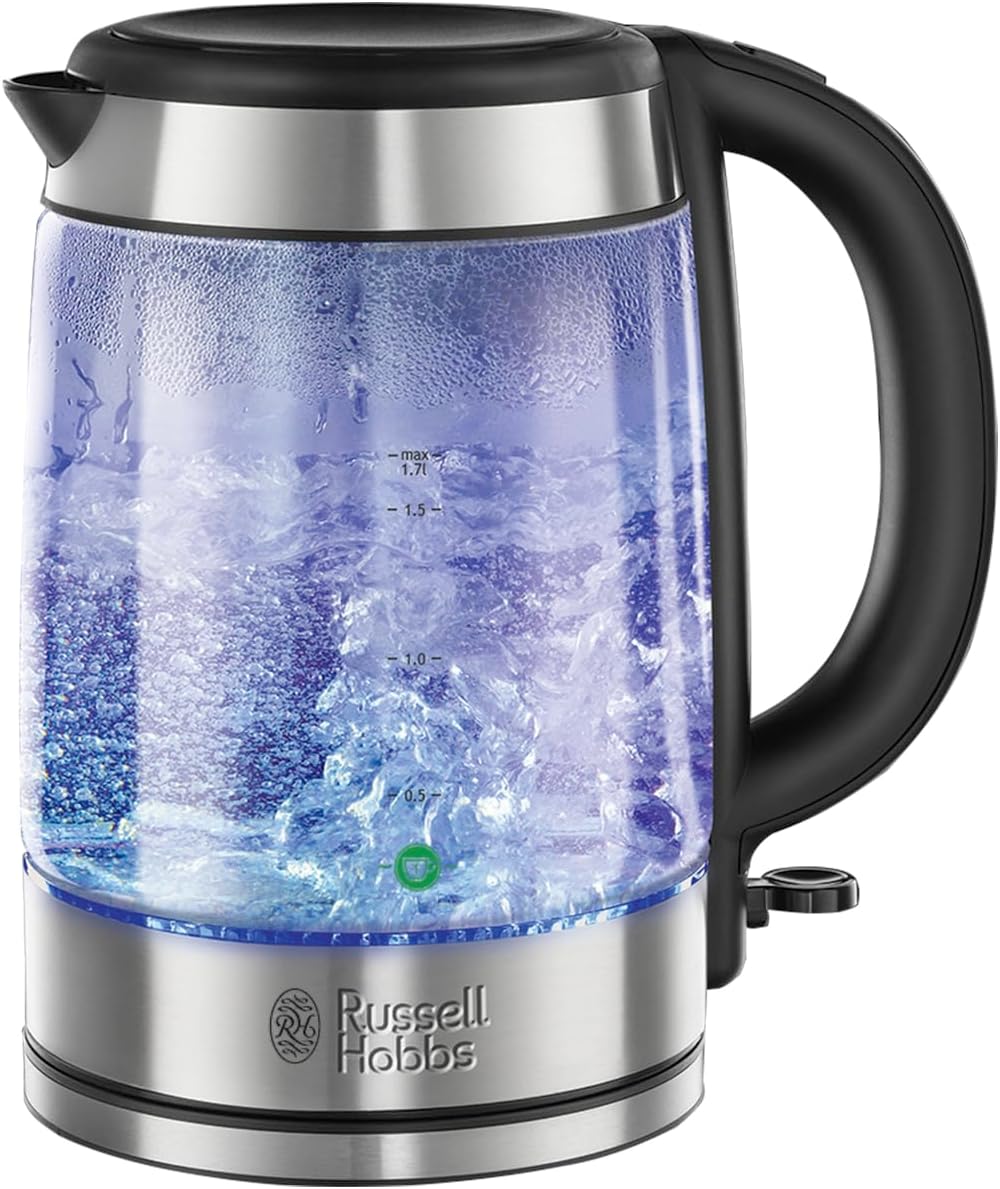
Russell Hobbs 21600-10 Illuminating Glass Kettle, 1.7L
£32–£50
The default UK glass kettle for good reason: a 3kW rapid boil, premium Schott glass jug with brushed stainless accents, and a blue illumination ring while it boils. The 1.7L capacity makes about six cups, and the washable anti-scale filter keeps the worst of the flakes out of your mug. It is widely stocked (Amazon, Currys, John Lewis), so prices are frequently discounted below the £50 RRP.
Pros
✓Fast 3kW boil — one of the quickest at this price
✓Full 1.7L capacity (roughly six cups)
✓Removable, washable anti-scale filter
✓Premium Schott glass with push-button lid and 360° base
Cons
✗Limescale is highly visible on the glass in hard water areas
✗Glass body gets hot to the touch during and after boiling
✗Interior can look cloudy from condensation between uses
What owners say
Mumsnet kettle threads repeatedly name Russell Hobbs as the safe default, with the caveat that any glass kettle will look scaly quickly in a hard water area unless you descale regularly.
Russell Hobbs 20760-10 BRITA Filter Purity Glass Kettle, 1.5L
£41–£60
The obvious answer to the number-one glass kettle complaint. A BRITA MAXTRA PRO filter sits inside the Schott glass jug and filters the water before it boils, cutting limescale and chlorine — so the glass stays clear far longer in hard water postcodes. You get the same 3kW fast boil as the Illuminating, and it holds around 4.5 stars from over 5,400 Amazon UK reviews. The trade-off is usable capacity: the filter eats into the 1.5L jug, giving roughly 1L (about four cups) of filtered boiling water.
✓Noticeably cleaner-tasting tea and coffee in hard water areas
✓3kW fast boil with blue boil illumination
✓First MAXTRA PRO filter included in the box
Cons
✗Only about 1L of usable filtered capacity (four cups)
✗Ongoing cost of replacement BRITA filters
✗Filtering slows how quickly you can refill and re-boil
What owners say
Mumsnet's hands-on review of this kettle in a hard water home found no limescale had formed in the base after nearly a month of daily use, and it is the model most often suggested in Mumsnet hard-water kettle threads.
The best sub-£35 glass kettle we found on Amazon UK, and one of the highest-rated in the category at around 4.6 stars. The borosilicate jug is paired with a food-grade stainless steel inner lid and base, so hot water touches glass and steel rather than plastic — a priority that comes up again and again in UK forum threads. A British Strix thermostat handles auto shut-off and boil-dry protection. At 2200W it boils a touch slower than the 3kW Russell Hobbs models, and the 1.5L capacity suits smaller households.
Pros
✓Excellent value, regularly under £30
✓Stainless steel inner lid and base — minimal plastic contact
✓Reliable British Strix thermostat and boil-dry protection
✓Around 4.6 stars from Amazon UK buyers
Cons
✗2200W, so slower to boil than 3kW rivals
✗1.5L capacity is smaller than the standard 1.7L
✗Glass still shows limescale quickly in hard water areas
Aigostar Electric Glass Kettle with Variable Temperature (CRIS 30OSX), 1.7L
£33–£45
If you drink green or white tea, boiling water scorches the leaves — this is the affordable glass kettle that fixes that. It offers five presets (60°C, 70°C, 80°C, 90°C and 100°C), a keep-warm function that holds temperature for up to two hours, and a removable stainless tea infuser so you can brew directly in the 1.7L jug. It uses a British Otter controller and 2200W element. The main caveat from owner reviews is long-term durability, with some units reportedly failing within the first year.
Pros
✓Five temperature presets from 60°C to 100°C
✓Keep-warm function holds temperature up to 120 minutes
✓Removable stainless steel tea infuser included
✓Full 1.7L capacity with British Otter controls
Cons
✗Some owners report units failing within a year
✗More parts and crevices to clean than a plain kettle
ASCOT Glass Electric Kettle, 1.5L Borosilicate, No Plastic Contact
£45–£60
The pick for anyone who wants zero plastic anywhere near their boiling water. The jug is thick borosilicate glass, and the inner lid, base, filter and spout are all food-grade 304 stainless steel — a spec that directly answers the 'glass or steel only' requirement UK forum users often set. The Danish-designed retro styling and gift-box packaging feel genuinely premium, and it carries strong Amazon UK ratings. Downsides: the 1500W element makes it the slowest boiler here (around five minutes for a full jug), and the RRP is high for a 1.5L kettle, so wait for one of its frequent discounts.
Pros
✓Completely plastic-free water contact, including the lid
✓Thick, scratch-resistant borosilicate glass with 304 stainless steel
✓Attractive Danish retro design; boxed well for gifting
✓Auto shut-off and boil-dry protection
Cons
✗1500W element is noticeably slower to boil (about 5 minutes full)
We read through public discussions on Reddit and UK forums so you don't have to. Every quote links to its
original thread — click through and read the full conversation.
Across Mumsnet and MoneySavingExpert kettle threads, UK owners broadly agree on three things. First, glass kettles look superb new but show limescale faster than any other type — in hard water areas the jug can look cloudy and scaly within weeks unless you descale regularly or use filtered water, and several owners in soft water areas report theirs staying spotless with zero effort. Second, avoiding plastic contact with boiling water is a genuine buying criterion for many, which pushes people towards glass-and-steel designs like the ASCOT and COSORI. Third, Russell Hobbs is the brand named most often as the safe default, with the BRITA Purity model the standard answer for hard water postcodes. Note: quotes below are close paraphrases of comments surfaced in our research, each linked to the original thread; direct thread access was limited, so exact wording may differ slightly.
“Her glass kettle looked "grubby, cloudy and scaley all the time" — after a few uses the transparent jug turned out to be an eyesore in their hard water area.”
“When shopping for a new kettle, one buyer's requirements were variable temperatures and no plastic in contact with the water — glass or steel only — plus a minimum boil of under 500ml.”
“In a quiet-kettle thread, one poster suggested the Molla P!ro cordless glass kettle because it doesn't make any noise — though they admitted it takes about 10 minutes to boil.”
“Testing the Russell Hobbs Purity in a hard water home: after nearly a month of daily use, limescale hadn't formed in the base, and drinks tasted cleaner — the built-in Brita filter genuinely makes a difference.”
Limescale: the big glass kettle problem in hard water areas
Most of southern and eastern England has hard water, and limescale forms every time you boil it. In a plastic or steel kettle you barely notice; in a glass kettle you see every fleck through the jug. UK owners on Mumsnet describe glass kettles in hard water homes as looking cloudy and scaly within weeks. Your options: pick a model with a built-in filter (the Russell Hobbs BRITA Purity), fill from a filter jug, or commit to descaling every two to four weeks with citric acid, lemon juice or a descaler gel — gels and descaler bags work best on glass because the residue is so visible. If you're in a soft water area (much of Scotland, Wales and the North West), ignore all of this — your glass kettle will stay clear with almost no effort. Our step-by-step descaling guide covers the routine that keeps a glass jug clear.
Temperature control: worth it if you drink anything besides builder's tea
Boiling water (100°C) is right for black tea and instant coffee, but it scalds green tea (best at 80°C), white tea (70°C) and burns fresh coffee (around 90–96°C). If you drink any of these, a variable-temperature kettle like the Aigostar CRIS pays for itself in better-tasting brews, and a keep-warm function means the second cup doesn't need a full re-boil. If you only ever make English breakfast tea and instant coffee, skip the feature — it adds cost, complexity and more electronics to go wrong.
Plastic-free contact: check the lid, not just the jug
A common request in UK forum threads is a kettle where boiling water touches no plastic at all — some people can taste plastic in the water, others simply want to avoid microplastics from repeated boiling. The catch is that many 'glass' kettles still have a plastic inner lid, water gauge or filter housing. Check the spec for stainless steel on the inner lid, base plate, spout filter and any water-level components. The ASCOT is fully plastic-free on the water path including the lid; the COSORI uses a stainless inner lid and base. 'BPA-free' alone does not mean plastic-free.
Capacity and boil speed: 3kW is the UK advantage
UK sockets support 3kW kettles — roughly double the power US buyers get — so there is no reason to accept a slow boiler unless you're trading power for another feature. The 3kW Russell Hobbs models are the quickest here; 2200W models (COSORI, Aigostar) take noticeably longer, and the 1500W ASCOT needs around five minutes for a full jug. On capacity, 1.7L makes about six cups, 1.5L about five, and filter kettles like the BRITA Purity give you roughly 1L of usable filtered water. Most kettles have a 500ml minimum fill; boiling only what you need is also the single biggest energy saving a kettle offers.
Durability and safety: what fails on glass kettles
Quality glass kettles use borosilicate or Schott glass, which handles thermal shock from repeated boiling — cheap soda-lime glass is the one to avoid. The components that actually fail are usually the lid mechanism, the LED ring or the thermostat, so favour kettles with a British Strix or Otter controller (COSORI and Aigostar both use them) and check recent owner reviews for failures inside the first year. Two practical notes: glass jugs get hotter to the touch than double-walled plastic or steel, so consider placement if you have young children, and glass kettles are generally louder than acoustically-damped 'quiet boil' designs.
Glass Kettles: frequently asked questions
Are glass kettles a bad idea in hard water areas?
Not necessarily, but go in with open eyes. Limescale forms just as fast in any kettle — glass simply makes it visible. UK owners in hard water areas report glass kettles looking cloudy and scaly within weeks without maintenance. Either choose a filtering model like the Russell Hobbs BRITA Purity, fill from a filter jug, or descale every two to four weeks. In soft water areas, glass kettles stay clear with almost no effort.
How do I remove limescale from a glass kettle?
Descale with citric acid or white vinegar: fill to cover the scale, boil once, leave 30 minutes, rinse well. In hard water areas repeat monthly. Full method, product comparisons and prevention tricks are in how to descale a glass kettle.
Do glass kettles boil water faster than plastic or steel ones?
The material makes little difference — power is what matters. A 3kW element (Russell Hobbs 21600 or BRITA Purity) boils a full jug in around three to four minutes; 2200W models take longer and 1500W models like the ASCOT need about five minutes. UK plugs support 3kW, so choose that if boil speed is your priority.
Is boiling water in glass healthier than in plastic?
Glass is inert, so it won't leach anything into boiling water or affect taste, which is why many buyers switch after noticing a plastic tang from old kettles. But check the whole water path: many glass kettles still have plastic inner lids or gauges. For genuinely plastic-free contact, look for stainless steel lids, bases and filters — the ASCOT and COSORI models here are the strongest on this.
Which glass kettle is best for green tea?
One with variable temperature control. Green tea brews best at around 80°C — boiling water scorches the leaves and turns it bitter. The Aigostar CRIS offers 60–100°C presets plus a keep-warm mode and a removable infuser for around £40, making it the best-value temperature-control glass kettle on Amazon UK in this round-up.
Are glass kettles noisier than normal kettles?
Generally yes, a little. A single-walled glass jug does less to muffle the roar of boiling than double-walled plastic or 'quiet boil' steel designs. If noise matters — open-plan kitchen, light-sleeping baby — note that lower-wattage kettles tend to boil more gently and quietly, but take longer; one MoneySavingExpert forum user recommended a quiet glass kettle that took around ten minutes to boil. It's a trade-off between peace and speed.
From our research
Deeper answers from the same owner-sourced research behind this guide.