
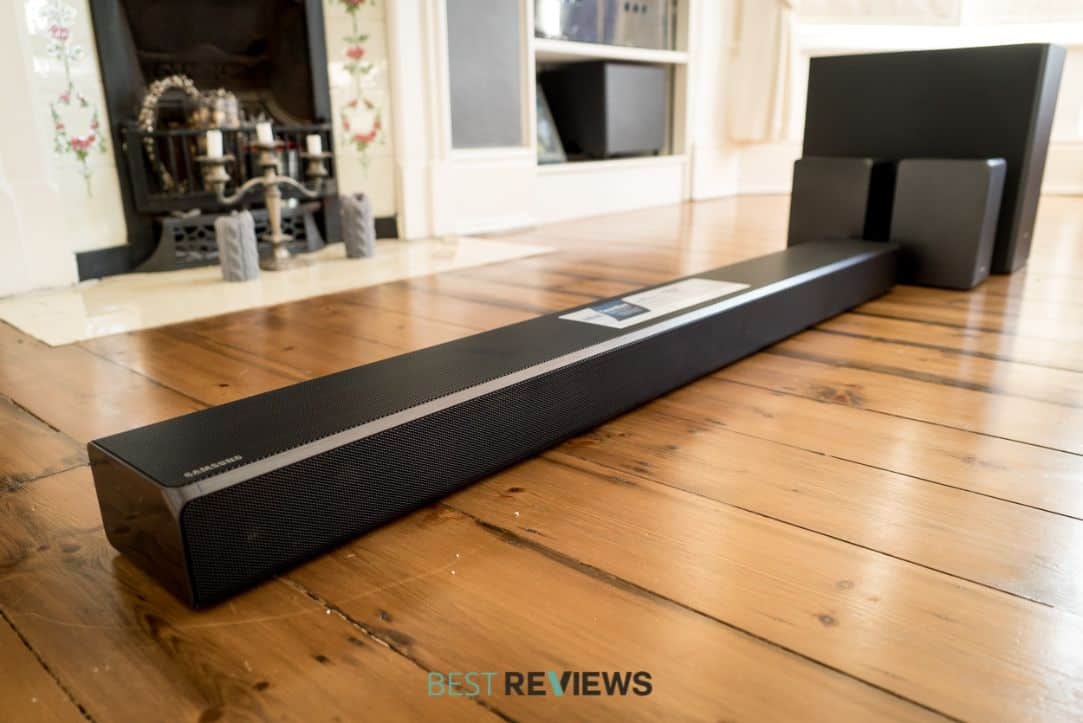
Yes, you can put a soundbar on the floor — but there is a meaningful audio quality trade-off that most guides gloss over. Soundbars are engineered to project sound at ear level, roughly 3–4 feet (90–120cm) from the ground when you're seated. Place one on the floor and you are working against its design.
That said, floor placement is not always avoidable. This guide covers when it works, how to minimise the downsides, and what the better alternatives are — so you get the most from your soundbar regardless of your setup.
Why Soundbars Are Not Designed for the Floor
To understand the problem, you need to understand how soundbars produce sound. Modern soundbars use a process called digital signal processing (DSP) to simulate surround sound. The electronics calculate the delay, timing, and direction of each audio channel so that sound appears to come from specific points in the room — left, right, above, behind.
That calculation assumes the soundbar is at approximately ear level, pointing horizontally toward the listener, with sound waves reflecting off the walls at predictable angles. When you place the soundbar on the floor, three things go wrong:
- Sound dispersion angle shifts downward. Instead of projecting toward your ears, the audio fires into your shins and bounces off the floor — where it gets absorbed by carpet or reflected at the wrong angle by hard flooring.
- The wall reflection paths change. Soundbars that simulate rear surround or height channels depend on sound bouncing off side and front walls at a specific angle. Floor placement disrupts these reflection paths, collapsing the sound stage.
- Dialogue clarity drops. Centre-channel dialogue is the most directional element in a soundbar's output. When the driver faces your knees rather than your ears, voices sound muffled or thin.
The difference is noticeable but not catastrophic. A soundbar on the floor still sounds better than built-in TV speakers. For background listening or music playback, it is a perfectly acceptable compromise.
When Floor Placement Actually Works
Despite the technical drawbacks, floor placement is a practical option in several real-world situations:
- Rented properties where wall mounting is not permitted
- Very small rooms (under 12 feet / 3.5m deep) where the shorter throw distance reduces the impact of angle issues
- Music-first listening — stereo music reproduction is less sensitive to placement height than surround film sound
- Bass-heavy content — low frequencies below 200Hz are largely non-directional, so action films and gaming can still sound impressive
- Temporary setups while you arrange a permanent position
The Best Position on the Floor
If you are placing your soundbar on the floor, where you put it matters more than whether you put it there. Follow these principles:
Directly Under the TV, Centred
Position the soundbar immediately below and in front of your TV, centred on the screen. This keeps sound as close to the visual image as possible, which helps your brain stitch audio and video together even when the angle is imperfect. Never place it to one side — off-centre floor placement produces noticeably lopsided audio.
Face Forward, Not Upward
Do not tilt or angle the soundbar upward from the floor. The drivers are optimised to project horizontally. Angling the unit creates diffraction around the cabinet edges and reduces clarity. Point it straight ahead.
Keep It Away from the Back Wall
Leave at least 5cm (2 inches) of clearance behind the soundbar if it has rear-facing ports or drivers. Soundbars with passive radiators or rear bass ports need breathing room.
Carpet vs Hardwood: Which Is Better?
Hard flooring (wood, tile) reflects sound upward from the floor more than carpet does, which can marginally improve floor-placed soundbar performance. However, hard floors also increase high-frequency reflections that can cause harshness. Carpet absorbs some of those reflections, giving a slightly warmer but slightly duller result. The difference is subtle — neither surface is significantly better.
Better Alternatives to the Floor (Ranked)
If floor placement is not your only option, here is where to put your soundbar instead, ranked from best to worst:
- On the TV unit, below the screen — the standard position. Sound fires directly at ear level, DSP works as intended, and cables stay tidy. This is correct for the vast majority of setups.
- Wall-mounted below the screen — ideal for wall-hung TVs. Maintains ear-level projection and keeps the unit secure.
- On a low shelf below the TV — a shelf at 30–50cm (12–20 inches) height is a reasonable compromise if you cannot mount and have no TV unit. Significantly better than the floor.
- Above the TV — works only if your soundbar has downward-firing drivers. Most standard soundbars do not. Avoid this unless your model explicitly supports it.
- On the floor — last resort. Better than nothing.
Do not place it behind the sofa or on a side surface. Off-axis placement at the wrong angle produces significantly worse results than floor placement directly under the TV.
Soundbars That Handle Floor Placement Better
Not all soundbars are equally affected by floor placement. Models with upward-firing Dolby Atmos drivers or wide vertical dispersion perform better on the floor because their height channels fire upward regardless of placement height.
If you are regularly using a soundbar on the floor, consider these UK-available options that are more forgiving of non-standard positioning:
- Samsung HW-Q990D — 11.1.4-channel system with upward-firing drivers. The height channels work effectively even from floor level. Check current price on Amazon UK.
- Sonos Arc — uses phase and reflection to simulate height channels. Less dependent on precise placement height than traditional soundbars. Check current price on Amazon UK.
- LG S95QR — 9.1.5 channels with multiple upward-firing drivers. One of the most placement-flexible soundbars available. Check current price on Amazon UK.
- Yamaha YAS-209 — budget-friendly option with DTS Virtual:X processing that compensates reasonably well for off-axis positioning. Check current price on Amazon UK.
For budget soundbars without height channels, the floor placement penalty is more severe — you lose the full surround simulation almost entirely, leaving mostly stereo output.
Tips to Improve Sound Quality from the Floor
If the floor is where your soundbar lives, these adjustments will recover some of the quality lost from improper positioning:
- Run the room calibration routine if your soundbar has one (common on Samsung, Sony, and Yamaha models). These systems measure the acoustic environment and compensate for non-standard placement.
- Increase the dialogue/centre channel level in your soundbar's EQ settings. Floor placement hurts voice clarity most — a +2dB boost to the centre channel partially compensates.
- Reduce the height channel level on Atmos soundbars. The simulated height channels will be less accurate from the floor, so reducing them avoids unnatural-sounding overhead audio.
- Sit closer to the soundbar. The audio degradation from floor placement is more pronounced at distances over 3–4 metres. Moving the sofa 50cm closer can noticeably improve perceived quality.
- Keep the area in front clear. Coffee tables, rugs, or anything blocking the line of sight between soundbar and ears absorbs or deflects sound. Even on the floor, a clear path matters.
Frequently Asked Questions
Can I put a soundbar face-up on the floor?
No. Placing a soundbar face-up so it fires toward the ceiling is worse than facing forward. Sound will reflect off the ceiling and arrive at your ears from the wrong direction with significant delay, producing a muddy, reverberant sound. The only exception is a soundbar specifically designed as an upward-firing unit — these are rare and usually used as add-on speakers, not standalone bars.
Is a soundbar on carpet worse than on hardwood?
Marginally. Carpet absorbs some of the floor-reflected sound waves, which slightly reduces lower-frequency output from a floor-placed soundbar. The difference is small — under 3dB in most cases. You will not notice a dramatic change when moving from carpet to hardwood.
How far from the TV should a soundbar be on the floor?
As close as possible — ideally touching the base of the TV unit or directly below the screen. Every additional metre of horizontal distance between the soundbar and the TV delays audio relative to the visual image. At more than 1.5 metres of separation, audio-visual sync becomes perceptibly off on fast-cut content.
Is it safe to put a soundbar on the floor with children or pets?
It is a risk. Soundbars placed on the floor are exposed to accidental kicks, spills, and pet interference. Most soundbars are not designed to handle impacts or liquid ingress. If small children or pets are present, a mounted or elevated position is strongly recommended — both for audio quality and to protect what can be a significant investment.
Will placing a soundbar on the floor damage it?
Not directly. The floor surface itself will not cause damage. However, floor placement increases exposure to dust accumulation in speaker grilles and ports, and increases the risk of physical damage from foot traffic. Clean the grille periodically with a soft brush if the soundbar lives on the floor long-term.
Does floor placement void the soundbar warranty?
No. There is nothing in any major manufacturer's warranty terms (Samsung, Sony, LG, Sonos, Yamaha) that specifies a required mounting position. Using a soundbar on the floor is a supported use case even if it is not the recommended one.
Can I put a soundbar under the sofa on the floor?
This is one of the worst positions for a soundbar. Placing it under or behind a sofa means the furniture physically blocks the sound path, heavily muffling high and mid frequencies. The result is bass-heavy, detail-poor audio. Never use this position.
The Bottom Line
You can put a soundbar on the floor, and in some circumstances — rented properties, small rooms, temporary setups — it is a reasonable compromise. What you lose is precision: the surround sound simulation, the clarity of dialogue at ear level, and the accuracy of any Dolby Atmos height effects.
If floor placement is unavoidable, put it directly under the TV facing forward, run any available room calibration, and boost the centre channel slightly. If you have any other option — a TV unit, a shelf, a wall bracket — take it. Even a 30cm elevation over floor level makes a measurable difference to how your soundbar performs.
Contents
- 1 Why Soundbars Are Not Designed for the Floor
- 2 When Floor Placement Actually Works
- 3 The Best Position on the Floor
- 4 Better Alternatives to the Floor (Ranked)
- 5 Soundbars That Handle Floor Placement Better
- 6 Tips to Improve Sound Quality from the Floor
- 7 Frequently Asked Questions
- 7.1 Can I put a soundbar face-up on the floor?
- 7.2 Is a soundbar on carpet worse than on hardwood?
- 7.3 How far from the TV should a soundbar be on the floor?
- 7.4 Is it safe to put a soundbar on the floor with children or pets?
- 7.5 Will placing a soundbar on the floor damage it?
- 7.6 Does floor placement void the soundbar warranty?
- 7.7 Can I put a soundbar under the sofa on the floor?
- 8 The Bottom Line


